

When you prepare for a public speaking event, it is worth answering the following questions:
✅ Why do I want to speak?
✅ What do I want to achieve with this speech?
Once you answer these two questions, it will be easier for you to choose the form of your speech. Remember that the form may be suggested by the nature of the event you will be participating in. Here, we focus on real-time speeches, where people can interact with you.
Short forms of speeches that you will probably encounter are.
✅ Formal speech, e.g., in parliamentary committees – here it is necessary to prepare the entire speech thoroughly and very substantively because the speech is most often a statement of position on behalf of the interest group you represent. This type of formal speech should be supported by very solid arguments. It is also worth analyzing other perspectives here so that your argument reaches people who are not convinced of your case.
✅ Lecture – presentation of a concept, issue – this is a structured form of communication, which you can give a casual or formal character, while it is fine to support yourself with a presentation here, it is not about reading the presentation from the screen. A lecture is usually a longer form of speech, so a solid knowledge of the subject is necessary because you will probably be asked questions at the end. However, this is a rather one-sided form, because it is mainly you who presents the topic. A lecture can, however, be a great opportunity to build a professional image.
✅ Speaking at a meeting with the local community – this can be charismatic, substantive, containing references to specific problems brought by the community, it aims to show that you are close to people and what they live for. Naturalness and establishing relationships are important here. It is necessary to have a very good understanding of the given community because they will recognize you as a leader or not.
✅ Leading a discussion – moderating a meeting of a group of people, the discussion usually has an imposed topic and should end with conclusions and a summary. It does not have to result in the agreement of all parties. It is important to set the framework for the discussion and maintain the culture of speech and ensure that everyone has space. This is also a great opportunity to show yourself as a leader who creates space, does not take it over, and is able to moderate people’s statements and manage the situation.
✅ Participation in a debate – participation in a discussion on a very specific topic, usually in front of an interested audience, requires very substantive preparation, because people with different points of view usually debate. A debate can be a great opportunity to show your strengths and your commitment. It can help many people to be convinced by you because they will see that you cope in situations that require preparation, composure, and quick reflection.
✅ Participation in a discussion panel – this is a form usually devoted to a specific issue or problem, it is often expert, requires orientation in each field, and good preparation. In terms of image, it can position you as an expert. If you discuss topics that are lively for a given community, people may start to perceive you as an advocate for their cause.
✅ Online presentations – webinars, events – here you need to prepare technically and substantively. It is good to have aids, such as a presentation, and a short film to maintain the concentration of the listeners. Also, pay attention to your online self-presentation, avoid patterned clothing and excessive detail, and take care of what people will see in your background. Make sure you have technical support with you, so you don’t have to worry about it during the presentation. Do a rehearsal before the main speech. You may need good headphones.
✅ Storytelling – this is a common method of attracting attention and gaining the favor of the audience. You can use storytelling in your speech. Beforehand, think carefully and prepare a story. It can be your story or someone else’s. It is very important that you know exactly why you are telling it. When preparing storytelling, remember 5 points that you should always include in your speech.
- How to start storytelling? From the so-called setting, or description of the time and place of action. You should simply describe the world in which something important is about to happen.
- Heroine/Hero – the heroine/hero is most often an ordinary person who faces an extraordinary challenge. Introduce this character to your audience.
- Opponent/Obstacle – talk about the difficulties that the heroine/hero has encountered. It is the battle between hero and adversary that is the backbone of the story. Conflict is the most important part of an interesting story.
- Plot twist – plan the turning point of the plot well, because it piques the curiosity and emotions of the listeners. The plot twist is the climax of the story.
- Resolution and moral – The victory of the heroine/hero over the adversities of fate is the framework of the whole story, the summary, the proof of her/his power. Storytelling, like a fable, should end with a moral.
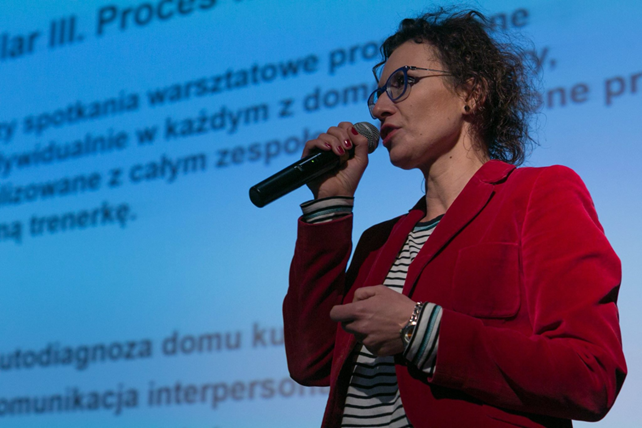
Before you speak in public, carefully analyze the form. If you have influence over your speech, choose the one that will be most effective for you.
If you are invited to an event, ask yourself exactly what form you will be speaking in and in what capacity you have been invited.
Then answer the following questions:
✅ Why have they invited me here?
✅ What can I gain by attending this event?
✅ What do I want to say?
✅ What goals do I want to achieve by participating?
✅ Do I need support?
Especially if you are just starting out, it is worth being oriented and prepared when appearing in public. People will remember you after the event and you can help yourself a lot if you come across interestingly and substantively in debates, on panels, or at meetings with politicians.
Things are completely different if you organize the event and invite the community to it; you have much more freedom in choosing the forms of the speeches and the invited guests.
Then it’s worth answering the questions:
✅ Why am I organizing this?
✅ What role do I want to play?
✅ What will be my most important message?
✅ Who do I want to invite?
✅ What form of meeting will best suit the goals I want to achieve?
✅ Whose support do I need?
👉 Public speaking can be a tool to build both interest in the topic you are talking about and your influence in the community. It is an opportunity to create an image that is consistent with you and what you care about. They can also serve to strengthen the integration of the community in which you operate. Therefore, approach public appearances very consciously, and you will feel more confident. Good preparation and knowledge of the audience are important.