
Understanding self-assessment
Self-assessment is the process of evaluating one’s own abilities, skills, and attributes to gain a clear understanding of personal strengths and areas for growth. It is a crucial step in both personal and professional development, helping us make informed decisions about our career and life goals.
Why does self-assessment matter?
Engaging in self-assessment brings several benefits that contribute to both personal and professional growth.
- Increased self-a Understanding one’s strengths and limitations allows individuals to make informed career choices, improve interpersonal relationships, and develop emotional intelligence and adaptability.
- Enhanced career d Self-assessment helps to identify suitable career paths based on strengths and interests. It is also important to improve job performance by focusing on skill enhancement and aligning career goals with personal values and aspirations.
- Improved personal g Self-assessment contributes to building confidence in one’s abilities, overcoming self-doubt and so-called impostor syndrome.
There are various methods and tools for self-assessment. Self-reflection is one of the simplest and most effective ways to gain insight into one’s skills and potential. Some useful techniques include:
- Journaling – Writing about personal experiences, challenges, and achievements helps recognize patterns and areas of strength.
- Self-Questionnaires – Answering guided questions about past experiences, problem-solving abilities, and work preferences.
- Experience Mapping – Creating a timeline of key experiences and identifying how they contributed to skill development.

The Hedgehog Concept
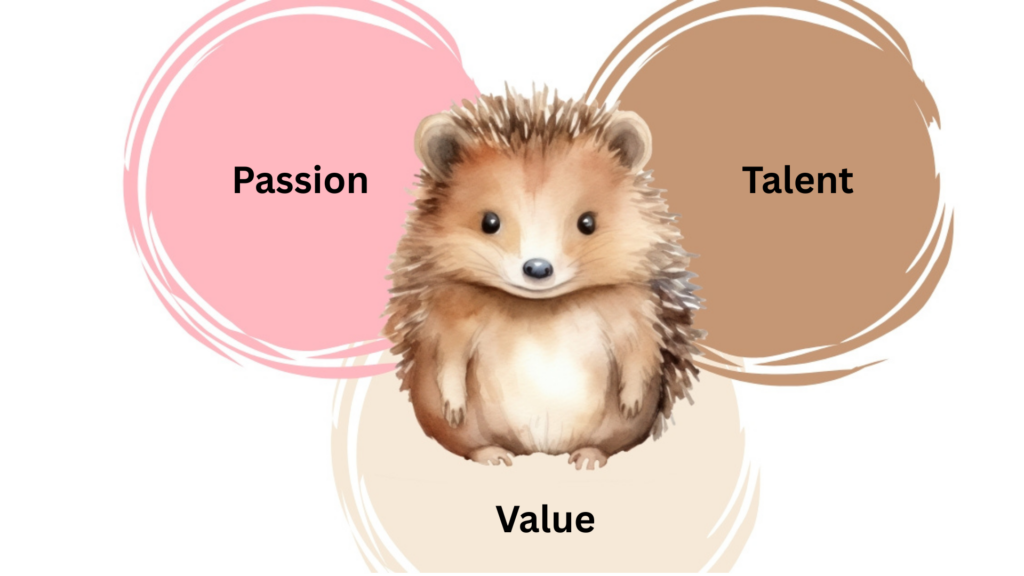
While diagnosing your resources and strengths, you can keep in mind the metaphor of the Hedgehog concept, developed by Jim Collins in his book “Good to Great.” The Hedgehog Concept comes from an ancient Greek parable. It explains that while the fox knows many things, the hedgehog knows one big important thing: it needs to protect itself and stick to its main strengths to succeed.
The Hedgehog Concept is all about focusing on what you do best and ignoring what’s not essential or outside your expertise. This focus helps you achieve your goals. It was developed for business purposes, but it can also be used by leaders in nonprofit or social sectors. In the context of personal development, it encourages individuals to:
- Identify Passion:
What truly excites and motivates you? What activities do you find yourself drawn to and passionate about, even if they require effort?
- Assess Skills and Talents:
What are you naturally good at? What comes easily to you, and where do you see yourself excelling with consistent practice?
- Consider Economic/Social Value:
How can you leverage your passion and skills to create something valuable that can be monetized or is needed by people, has value for others?
Your “Hedgehog Concept” is an intersection of those 3 circles. You can use various self-assessment methods to work on finding answers to Circles 1 and 2. Then, look in your environment to find an external value of your passions, skills, and talents.
👉 As you can see, you can start working on discovering your strengths and potential by asking yourself some questions and writing down the answers. However, there are also some more structured tools based on psychological theories and competency frameworks. You will discover some of them in the next chapter.