
Digitalization, automation, robotics and the use of AI are constantly expanding into fields where we might not have imagined it just a few years ago. Especially with the advent of AI, many industries have been given a fast wind in their sails and we can’t help but wonder how the world is changing around us.
Let’s take a look at a few specific examples that have already become a reality and we are quickly getting used to them:
- ✅ Agriculture – AI models that analyse satellite imagery and predict harvests, automated greenhouses with minimal water consumption or autonomous tractors and agricultural drones are being used in agriculture.
- ✅ Catering and hospitality – you may have already encountered robots that take away used dishes or AI chatbots that handle reservations, check-in and customer enquiries in hotels.
- ✅ Art and creative industries – there are already many AI tools that can create images and artwork to simple specifications. You may have seen some of the deepfake videos
- ✅ Archaeology – satellite imagery and AI models help reveal ancient sites without digging or deep learning helps reconstruct destroyed artwork.
- ✅ Fashion and cosmetics – it is already possible to try on clothes and make-up virtually or use AI to analyse skin and design customised beauty products.
- ✅ Spirituality and religion – new AI chatbots are emerging that can answer questions from believers.
- ✅ Sport and fitness – smartwatches using AI to analyse sleep, recovery and performance or apps that can create personalised exercise plans are already being actively used.
- ✅ Judicial – in the legal field, we can see AI legal assistants helping to draft legal documents or review contracts, and predictive models that can forecast the likely outcome of litigation based on historical court decisions.
👉 How has the rise of AI impacted your personal and professional life? Can you think of any other examples of the use of modern technology and AI in everyday life? Let’s now take a look together at how digital technologies and tools are impacting the world of work and how they may also affect our professional lives.
In 2023, the World Economic Forum released “The Future of Jobs Report 2023” (WEF 2023), which provides key insights into how jobs and the skills needed for career success will evolve in the coming years. Now in its fourth edition, the report analyses employers’ expectations and shows what technological and socio-economic trends will shape the workplace of the future.
Let’s now take a look at the most important insights that must also be taken into account when planning our career development and self-education:
- ✅ The need for continuous learning and adaptability
The need for lifelong learning and the ability to keep up with change is crucial given that by 2027, more than two-fifths of basic skills are expected to change as a result of technological advances. The ability to work with AI and big data, analytical and creative thinking will become increasingly important.
- ✅ The rise of remote working and the expansion of talent networks
In the wake of the global Covid-19 pandemic, the expansion of remote working has accelerated, giving many organisations the opportunity to collaborate with talent across the globe.
- ✅ Expanding use of digital tools and technologies
Another expectation is that by 2027, up to 75% of organisations will be using advanced technologies such as artificial intelligence, big data and cloud computing. This will lead to an increase in the demand for workers with these skills.
- ✅ Changes in demand for jobs
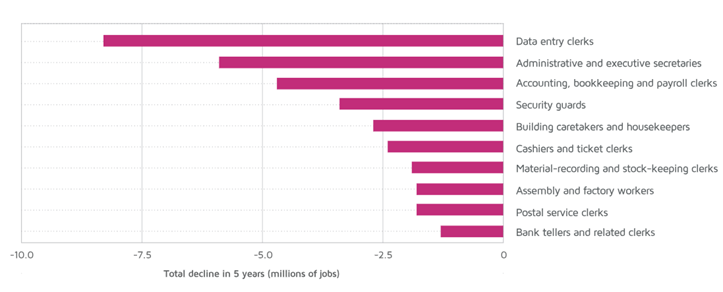
In connection with the above changes, there will also be an increase in demand for specialists in artificial intelligence, data analytics or sustainability. Conversely, purely routine administrative positions will be in less demand due to automation. In the figure below, we can see which positions are expected to see the biggest drop in demand.
👉 The impact of digital technologies and related changes in their use by the labour market will have a significant impact on the career paths of many workers. For this reason, it is important to keep abreast of current trends. However, we need to be aware also of possible adverse effects of digitalisation and especially of the use of AI which is connected to diverse controversies. Lets have a quick overview of these aspects.
Digitalisation and especially artificial intelligence (AI) is often a topic of heated debate. On the one hand, these technologies are powerful tools that can bring enormous benefits to learning, work, and everyday life. On the other hand, their impact is not always positive and raises important questions for the education sector.
For example, some researchers and educators argue that heavy reliance on digital tools may lead to a loss of social and cognitive skills. In Scandinavian countries, there is even a noticeable shift back toward more traditional, analogue forms of learning. Concerns about screen addiction are also widespread. In some schools in different countries, smartphones are banned for students. This shows how seriously educators take the possible negative effects of digital technology on young people’s development.
These debates raise a crucial question: do digital tools really improve brain activity and thinking skills, or could they actually weaken them? Some studies suggest the latter – that overuse of digital technology may reduce certain cognitive abilities, even though these tools are designed to support thinking and learning.
A related concern is whether digitalisation is contributing to a decline in discursive thinking – the ability to engage in thoughtful, reasoned dialogue. If so, what might this mean for how we teach, learn, and interact in the future?
Another concerns are connected to data protection, privacy, surveillance, energy consumption, and sustainability. Researchers question whether digitalisation is truly “green.” Risks include cybercrime, government use of data for surveillance purposes, and lack of transparency. While services appear free, users often “pay” with their personal data, fueling profits for companies.
👉 For more information on these aspects, look at our other module “Digitalisations, AI and gender (in)justice”. Now, let’s have a closer look at another aspect of digitalisation – far from everyone has the same conditions and access to modern technologies, which can create further differences. What are these barriers and how to overcome them?