
The gender-specific pay gap, the gender pay gap, in turn reflects power relations. Not only because women per se earn less in positions below executive level. But also because the level of income is negotiated — and is thus also a question of power. And because incomes in so-called women’s professions, such as care work or adult education, are set lower than those for the work of female engineers, IT specialists, and others, a power relationship also becomes apparent in this structural respect.
The EIGE Gender Equality Index offers an overview of the situation in the individual countries of the EU. A distinction is made between financial resources (median annual income, gender pension gap) and economic situation (relative income within couples, in-work poverty risk).
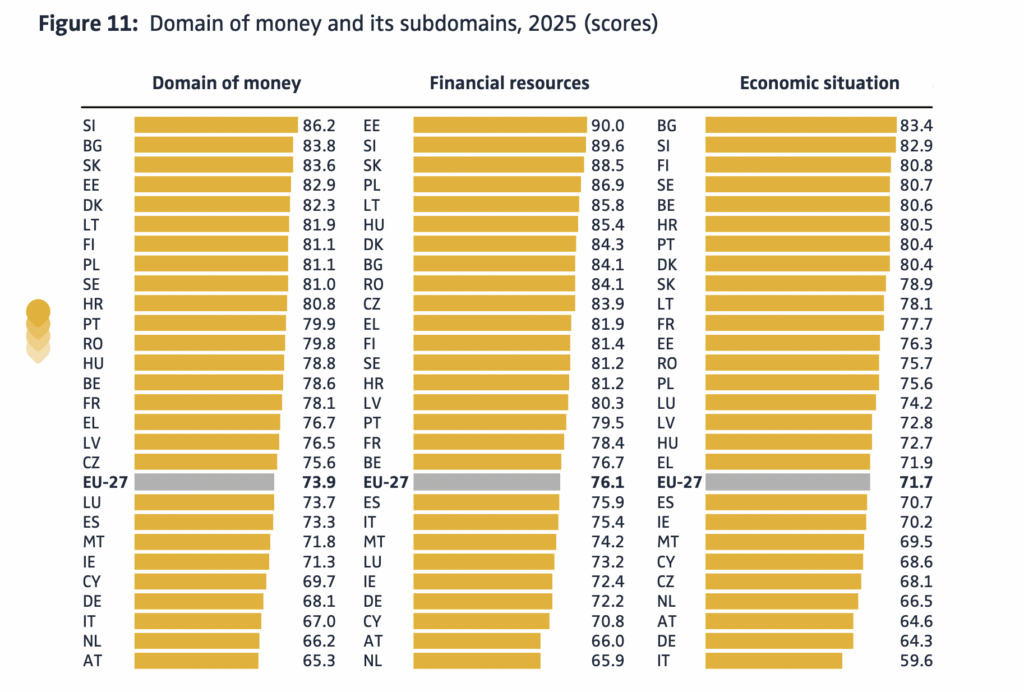
The authors of the study note, however, that statistical recording is fraught with difficulties. With regard to the measurement of in-work poverty risk, the analysis of single-person households shows that in the EU, 16% of employed women and 13% of employed men have insufficient household income to cover their basic needs. The analysis of multi-person households assumes that income is distributed equally between the man and woman of the household. But equal access to income, wealth, and decision-making power within households is not automatically given. The power of economic difference still all too often manifests itself within the family as well — and is therefore also difficult to determine. [1]
A lack of gender equality is expensive. The European Foundation for the Improvement of Living and Working Conditions (Eurofound, an agency of the European Union) determined that the gender employment gap — that is, the different rates of employment among men and women — “… taking into account lost income and missing social contributions by the individual to society, as well as the costs to public finances — amounted to over 390 billion euros in 2023, which corresponds to 2.3% of the EU’s GDP.” [2]
The gender pay gap in the countries of the European Union differs considerably. It amounts, on average, to 11.1% of women’s gross hourly earnings compared to men’s in 2024. For Luxembourg, a negative value is recorded. This means that women in that country earn, on average, more than men.
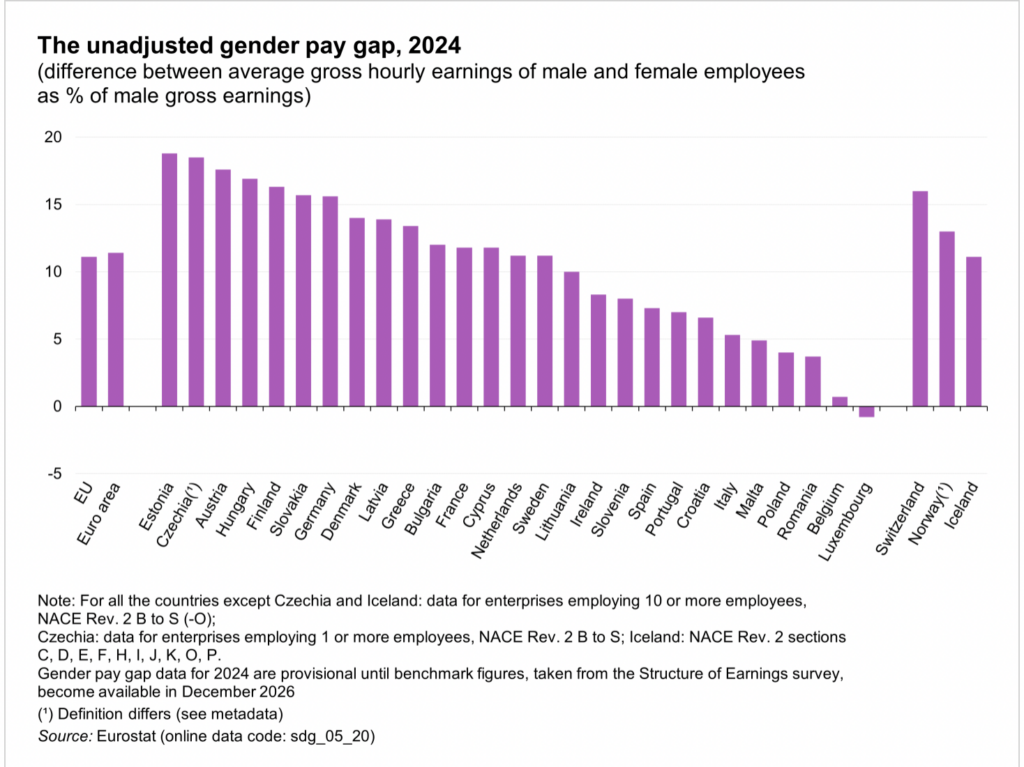
The pay gap between women and men remains considerable to this day. Differences between individual EU countries are striking. The topic has reached politics and the public. And yet there are pitfalls lurking.
References
[1]EIGE Gender Equality Index, https://eige.europa.eu/publications-resources/publications/gender-equality-index-2025-sharper-data-changing-world, p. 57
[2]Eurofound, press release of March 4, 2025, 09:00, https://www.mynewsdesk.com/eurofound/pressreleases/mind-the-gap-gender-employment-gap-cost-europe-over-390-euros-billion-in-2023-3373047