
What characterizes the gender power gap?
Especially in the 20th century, more rights were won for women. Such as the right to vote and to be elected, to work and earn one’s own income, and to own one’s own property. Yet social, economic, and political gender justice still shows significant deficits.
António Guterres, Secretary-General of the UN since 2017, emphasizes in his statement on facets of insufficient gender justice “… that gender equality is fundamentally a matter of power.” Patriarchy and centuries of discrimination have created a deep disparity between the genders in politics and business. Guterres addresses both personal and structural factors. Women who are in leadership positions or in public still experience threats and harassment. All too often, men are the norm and women the exception; their achievements are overlooked; they are “routinely” judged by their appearance. They are still often exposed to myth-making and ignorance about their bodily functions.
The power gap between the genders thus affects all areas of society. In a narrower sense, it encompasses the question of whether women are represented, and can exercise influence, at all hierarchical levels of the economy, science, social organizations, and politics in proportion to their share of the population. In a broader sense, it also addresses other aspects of gender injustice, since these in turn reflect unequal power relations. [1] This also essentially includes the gender pay gap.
What is the situation in detail?
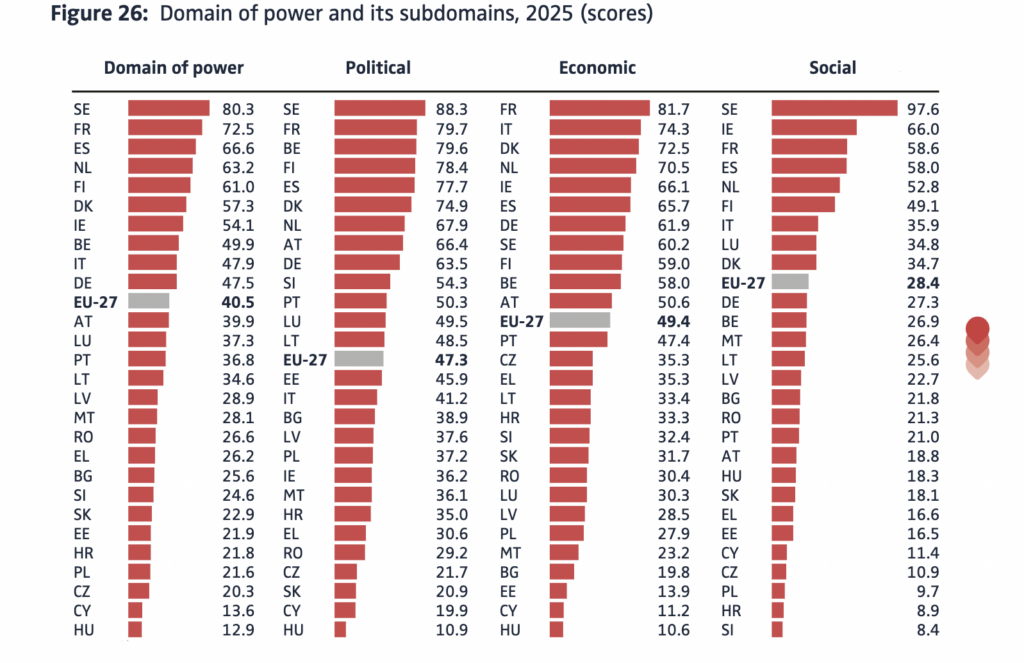
The Gender Equality Index of the European Institute for Gender Equality (EIGE) breaks down inequality into seven sub-areas: work, knowledge/education, money, time, power, health, violence. Inequality is greatest in the area of the distribution of power, even though the greatest progress has been made in this area since 2020. The figures are differentiated according to political power (ministries, parliaments, local interest representations), economic power (boards of the largest listed companies), and social power (leadership positions in the organizations of the ten most important Olympic sports in each EU member state):
The index according to all sub-areas and broken down by individual member states:
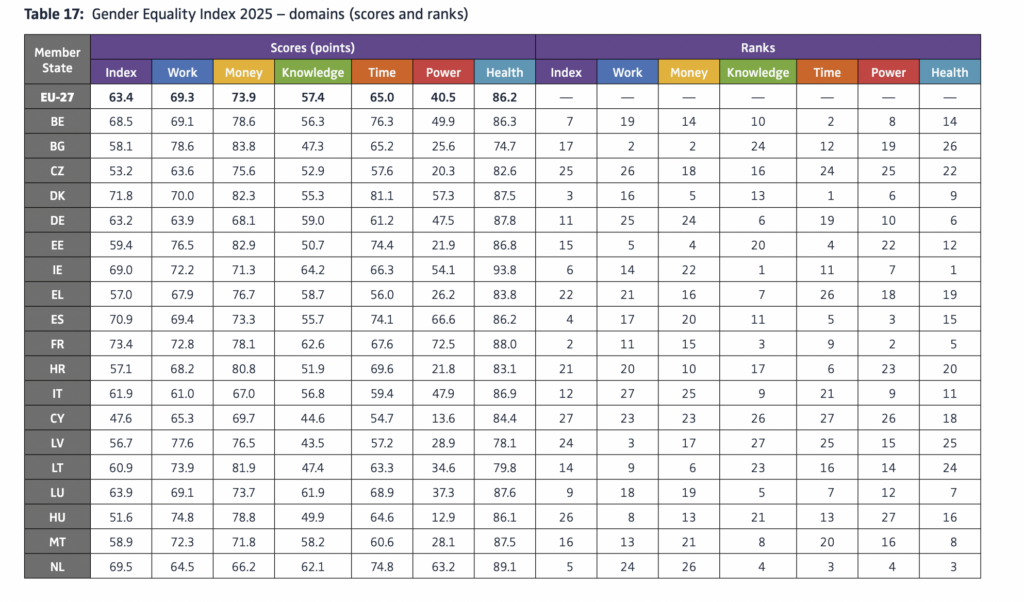
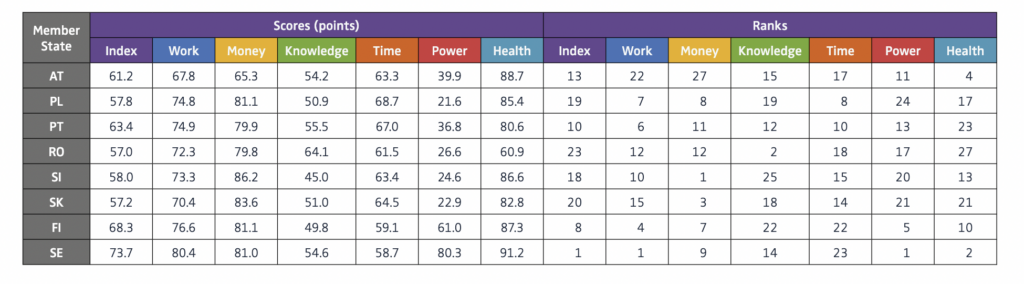
The Scandinavian countries and France stand out positively. For the Nordic states, this is attributed by some observers to social benefits for women and their rights in connection with family planning. [2] But this may also apply to the situation in France.
The researchers have also examined the “glass ceiling” for women with regard to stereotypes, role models, and prejudices. This concerns characteristics that are linked to leadership functions, such as:
“… independence, self-confidence, dominance, and assertiveness are often associated with masculinity and are expected of men in leadership positions. The characteristics and behaviors expected of women in public life, on the other hand, focus on community and community-building. Characteristics such as empathy, kindness, service orientation, and cooperation (Abele et al., 2007; Koburtay et al., 2019; Tremmel et al., 2023). Women are thus expected to show both initiative and a sense of community in order to achieve leadership positions (Zheng et al., 2018). As a result, as leaders they must reconcile two often contradictory behavioral patterns — with corresponding consequences (Johnson et al., 2008).”[3]
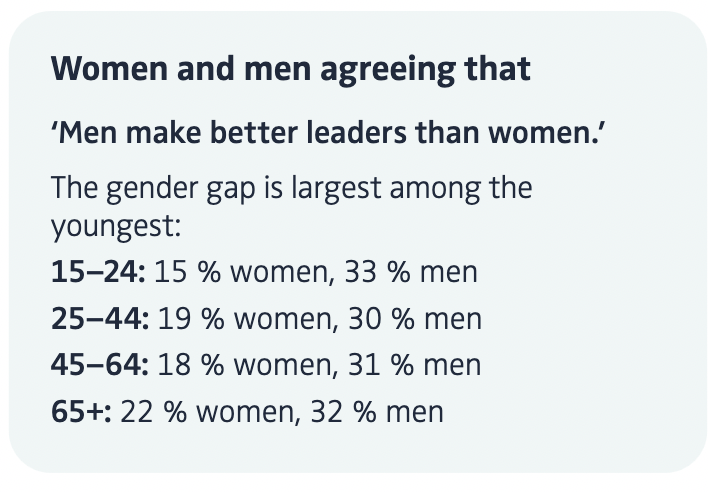
The report also notes that the statement “men are better leaders than women” receives the greatest agreement among young people aged 15 to 24. In the other age groups, the figures hardly differ:
Stereotypes can also result from a paradox, more precisely: from the fact that it is often women who take on leadership positions in organizations/companies that are in a crisis situation or failing and have only limited resources. If it does not succeed in leading the company or organization to success, this reinforces prejudices against women as leaders. At the same time, it can be observed that in times of political polarization, geopolitical conflicts, economic uncertainty, and ecological problems, so-called soft skills are required. 63% of the population in the European Union agree that these skills, often attributed to women, are needed in order to be a good leader. [4]
However, the report does not provide information on individual sectors. It thus remains an open question to what extent the gender power gap occurs, for example, in the digital sector or the financial sector — and whether setbacks or rather progress can be observed.
The gender power gap goes hand in hand with the financial power gap. Those who attain fewer leadership positions have, per se, a lower income — given equal qualifications. What picture emerges for the European Union? Let’s take a closer look.
References
[1]Guterres, António, The gender power gap, 02/03/2020, https://www.un.org/sg/en/content/secretary-general/articles/2020-03-02/the-gender-power-gap (25/08/2025)
[2]Statista, Gender equality in Europe – Statistics & Facts, published by Espinosa, Catalina, 17/12/2025, https://www.statista.com/topics/3719/gender-equality-in-europe/#topicOverview (07/01/2026)
[3]EIGE Gender Equality Index, https://eige.europa.eu/publications-resources/publications/gender-equality-index-2025-sharper-data-changing-world, p. 90
[4]EIGE Gender Equality Index, https://eige.europa.eu/publications-resources/publications/gender-equality-index-2025-sharper-data-changing-world, p. 92