Let’s start with an image:
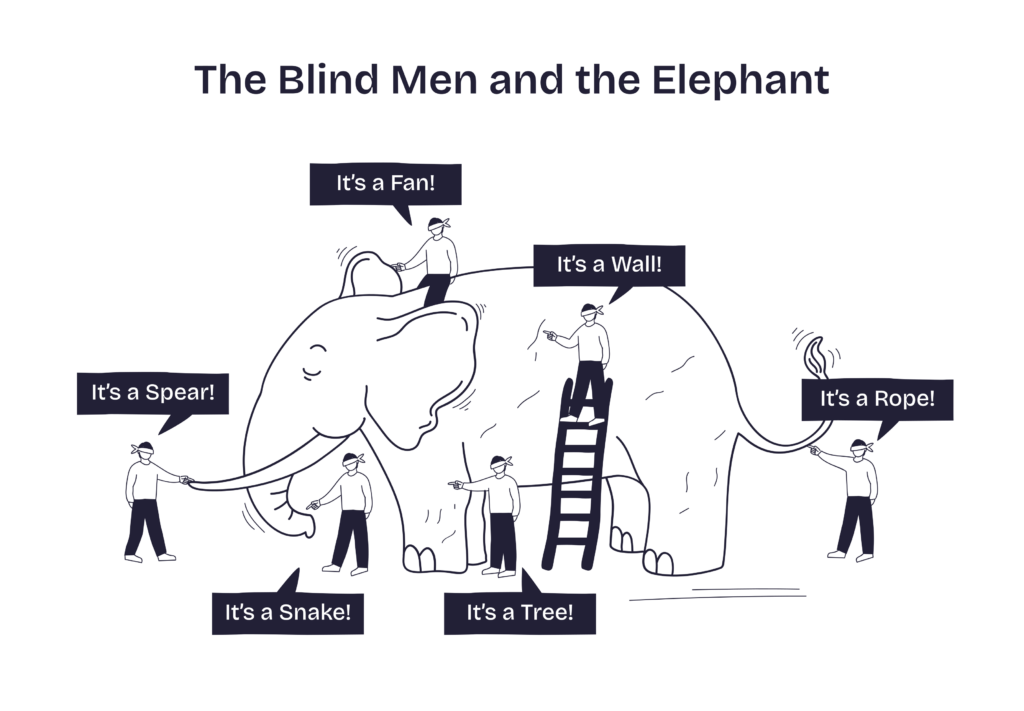
Levels of observation
The elephant stands for the whole and its parts. However, one can sometimes fall into the fallacy of mistaking individual parts for the whole. Why? Possibly no immediate, practical benefit is expected when thinking about something over which one believes one has no influence. “Nothing can be changed anyway.” But is that so?
The image of the elephant illustrates that reality is complex. Anyone who does not grasp the whole, who blanks out the “larger context,” will misinterpret the individual parts and mistake the trunk for a snake, the ear for a fan.
Sociologists attempt to grasp social reality and distinguish between the micro level of individual action, the meso level of organizations, and the macro level of social and economic structures, political frameworks, and current epistemes in the sense of socially discussed bodies of knowledge that preform perception and thought. The question is: how much society is present in the individual? And vice versa? In what way does the individual shape society?
EXAMPLE
Today it is taken for granted that women are employed. Today women can also exercise both active and passive voting rights. These freedoms had to be fought for hard over decades. For it to become self-evident that the gender power gap is overcome and that women equally take on leadership functions, progress is needed both at the structural level of politics and the public sphere and through women themselves.
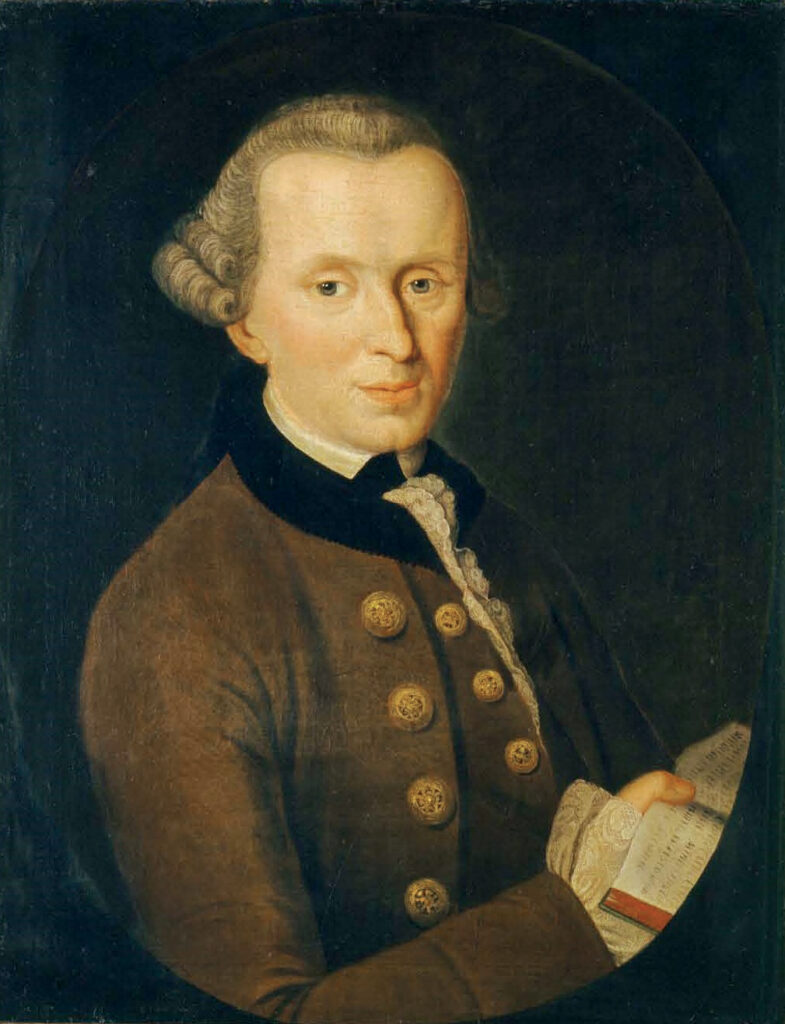
Does that sound theoretical? What is sometimes overlooked: theory is often practical. The reflections of Immanuel Kant (1724–1804) on the civil constitutional state and the place he assigned to women within it had an effect well into the 20th century and reinforced conservative role models and a corresponding division of labor. At the same time, the idea of emancipation, of freedom and equality, triggered waves of women’s movements that fought for new rights and (professional) opportunities for women. Micro and macro levels are thus intertwined. Comprehensive gender justice can therefore only exist in a broad sense: anchored and legally secured in the structures of the economy, politics, science, culture, as well as through the courageous actions of women and men themselves.
Such an approach also opens up more potential for action toward gender justice in times of change. For when societies and geopolitical power relations are in upheaval, a re-traditionalization of gender relations can quickly occur. Gender issues can also be used as instruments in generating social divisions. Seeing through these power strategies helps to breathe new life into the emancipatory spirit of progress toward greater gender justice. And this holds even when it often seems unclear whether individuals can achieve anything with regard to society as a whole. But the “whether” is less the question. Because: “People know what they do; they frequently know why they do what they do; but what they don’t know is what what they do, does.” (Michel Foucault)