
Artificial Intelligence is often portrayed as a cutting-edge tool — futuristic, rational, and free from human error. But in reality, AI is not a neutral force. It is a product of human choices: the data we feed it, the questions we ask, and the assumptions we carry. These choices are shaped by existing power structures — including gender-based hierarchies.
In many cases, AI systems amplify existing inequalities instead of correcting them. This is especially true when they are developed without intersectional awareness — that is, without recognizing how overlapping identities (gender, race, class, disability, sexuality) influence people’s experiences.
Gendered Data and Invisibility
One of the most significant problems is the lack of representative data. AI systems learn from existing data — and if women’s lives are underrepresented or distorted in that data, the AI will replicate that invisibility.
Some examples include:
- Medical AI tools trained predominantly on data from white, male patients, resulting in misdiagnoses and poorer outcomes for women and people of color. For instance, heart attack symptoms in women are often different than in men — but diagnostic tools may not account for this.
- Crash test algorithms and car safety designs that use male body standards as the default, making vehicles less safe for women and pregnant individuals.
- Personal finance AI systems that rank women as higher-risk borrowers due to systemic income disparities and traditional caregiving roles — not individual financial behavior.
The consequences are not theoretical. These tools are increasingly used to allocate resources, assess risk, and automate decisions in health, employment, education, and public safety. If gender bias is built in, it gets scaled up — affecting millions.
AI: A Tool of Reinforcement or Transformation?
Because AI reflects the priorities of those who build it, it can either reproduce dominance or challenge it. If left unchecked, it can deepen patriarchal norms — but if developed intentionally, it can redistribute power and increase visibility for underrepresented groups.
AI has the potential to:
- Surface patterns of gender-based violence or harassment, helping shape better policy.
- Detect and correct bias in historical datasets.
- Provide inclusive language tools that support gender-diverse identities and cultural contexts.
- Enable more accessible and adaptive learning for women in rural and low-income communities.
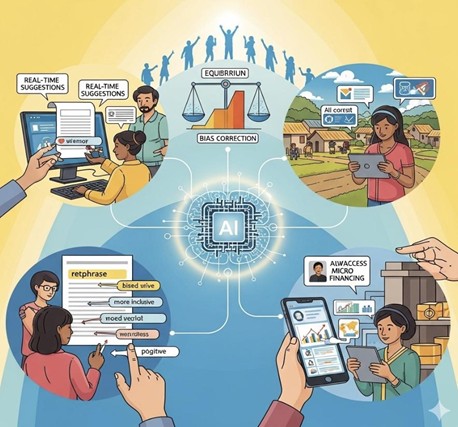
But these outcomes depend on who is involved in the design process, whose needs are prioritized, and what values guide development. Gender-aware, participatory design is essential to ensure AI helps dismantle, rather than reinforce, existing hierarchies.