
Artificial Intelligence has a reputation for being objective — based on data, not opinion; governed by logic, not prejudice. But this perception is dangerously misleading.
AI systems are trained on data produced by human societies — data shaped by our histories, inequalities, and prejudices. Algorithms reflect the values of their developers, the biases of their datasets, and the structures of the societies in which they are deployed.
This means that bias is not a bug in AI — it is often a feature.
Common examples of gender bias in AI include:
- Voice assistants (like Siri, Alexa, or Google Assistant) that default to female voices, programmed to be helpful, submissive, and polite — reinforcing outdated gender norms about women as caregivers or secretaries.
- Facial recognition systems that perform significantly worse on women — especially women with darker skin tones — leading to misidentification and wrongful surveillance. A study from MIT Media Lab found error rates as high as 34% for darker-skinned women, compared to less than 1% for lighter-skinned men.
- Hiring algorithms that “learn” from historical data — where men were favored in technical roles — and thus penalize resumes with female-coded names, or those that reflect maternity leave or “non-linear” career paths.
- Healthcare algorithms that underdiagnose women, particularly in areas like heart disease, because they were trained on predominantly male datasets.
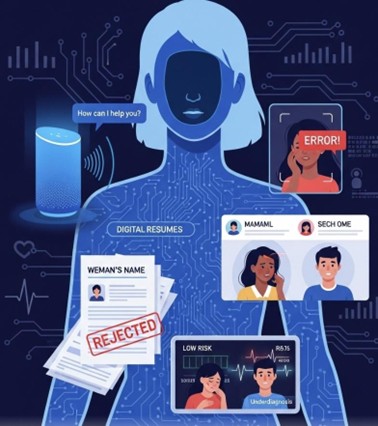
These biases can have life-altering consequences. A flawed algorithm may deny someone a job, delay critical medical treatment, or falsely flag someone as a security risk. And because AI decisions are often opaque or proprietary, challenging them can be difficult or impossible.
Moreover, these issues compound across identities. For example, transgender and non-binary individuals are routinely misclassified or excluded by systems that rely on binary gender categories. Indigenous and Global South populations may be missing from datasets altogether, leading to tools that simply don’t work for them.
Fixing these issues is not just a technical challenge — it is a political and ethical imperative. It requires:
- Diversifying teams who design and test AI systems.
- Interrogating data — where it comes from, whose lives it represents, and what it leaves out.
- Rethinking design values — not just accuracy or efficiency, but fairness, safety, and accountability.
- Establishing regulations that ensure AI systems are audited for bias and that their creators are held responsible for harm.
Most importantly, it demands a shift in mindset: away from seeing AI as “neutral” and toward recognizing it as a human-made tool — one that can either reinforce oppression or promote justice, depending on who builds it, how, and why.
There are already inspiring projects putting feminist AI values into practice. For example, Feminist Generative AI Lab works with marginalized communities and inclusive datasets; PartialJustice (Horizon Europe) centers participatory algorithmic justice; Women Reclaiming AI is reclaiming women’s voices in conversation AI and visual datasets; GeoChicas shapes how mapping technologies represent women in public space. These examples show not just what could be — but what is being built now.