
Ethics in AI is not a luxury or afterthought — it is a core requirement for justice and equity. Without ethical grounding, AI systems can cause unintended harm and reinforce structural oppression. And yet, many ethical AI frameworks fail to include gender as a central concern — or treat it as an afterthought.
To create ethically sound, gender-aware AI, we must understand ethics not just as abstract principles but as practical, enforceable actions shaped by inclusive values.
Core Ethical Principles in Gender-Responsive AI
Transparency
- People should know how AI systems make decisions and what data they rely on.
- Example: A hiring AI should disclose which factors affect candidate scoring and allow for human review.
Accountability
- Developers, companies, and institutions must be held responsible for outcomes — especially when harm occurs.
- There must be clear channels for complaint, redress, and correction.
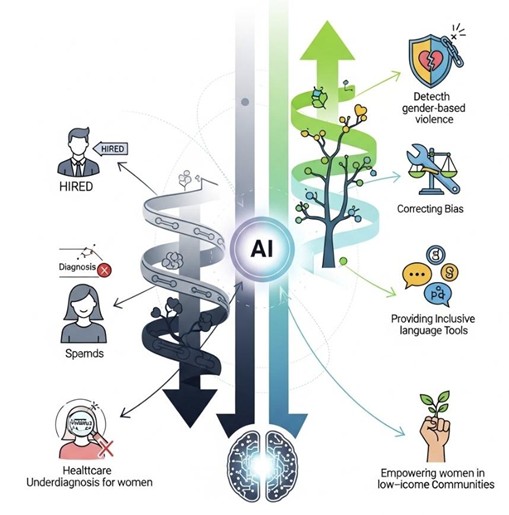
- Example: If a medical AI misdiagnoses women at higher rates, regulators must enforce audits and companies must provide accessible appeals for patients.
Equity
- Systems should be proactively designed to redress bias, not just avoid it.
- Equity means asking: Whose interests are being served? Who is left out?
- Example: Credit-scoring AI could integrate women’s informal economic activity, preventing systemic exclusion of female entrepreneurs.
Consent and Agency
- Individuals should have a say in how their data is used.
- For many women and gender-diverse people, data privacy is a safety issue — especially in authoritarian regimes or patriarchal contexts.
- Example: A health-tracking app should request explicit consent before sharing reproductive health data with third parties, protecting users in restrictive environments.
Intersectionality
- Ethical AI must account for intersecting identities — understanding that gender bias looks different when combined with race, class, disability, or location.
- Example: Facial recognition software should be tested across diverse groups, as women of color with darker skin tones are disproportionately misidentified.
From Guidelines to Practice
International bodies such as UNESCO, the European Commission, and the OECD have developed AI ethics principles. However, many companies and governments still lack binding mechanisms to enforce these values.
Without enforcement, ethics can become performative — a marketing buzzword rather than a safeguard.
To avoid this, ethical frameworks must be:
- Legally enforceable — with regulation and penalties for harmful systems.
- Participatory — involving affected communities, not just elite stakeholders.
- Context-sensitive — responsive to different gendered realities in various cultural settings.
Ethics is not only about doing no harm. It is about doing good intentionally — using technology to challenge oppression and foster empowerment.