
Technology can be a catalyst for empowerment — but only if women have the tools, opportunities, and spaces to lead its creation and use. Structural inequalities in education, capital access, and workplace culture mean that women often start from a disadvantaged position. Reversing this requires intentional, well-funded strategies.
Empowerment in Action: What Works
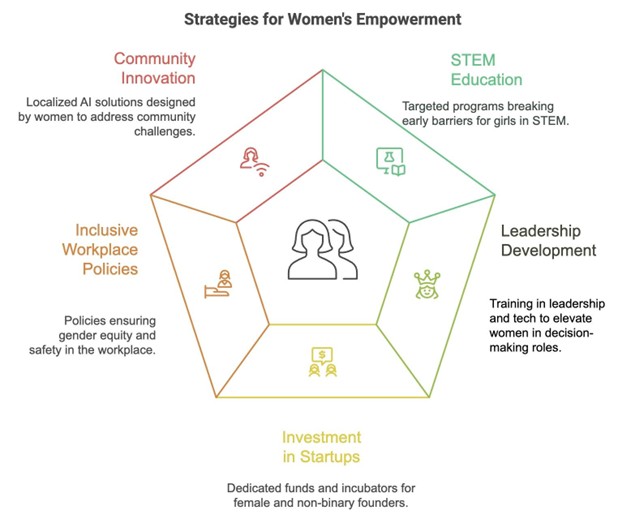
1. STEM Education and Mentorship
- Targeted programs for girls and young women, particularly in underserved regions, are key to breaking early barriers.
- Example: Girls Who Code has reached hundreds of thousands of students globally, narrowing the confidence and knowledge gap.
2. Leadership and Skills Development
- Providing training in leadership, negotiation, entrepreneurship, and advanced tech helps women rise to decision-making roles.
- Example: The Women in AI Leadership Lab supports mid-career professionals transitioning into leadership in the AI industry.
3. Investment and Support for Women-Led Startups
- Women receive a fraction of global venture capital. Dedicated funds and incubators for female and non-binary founders are essential.
- Initiatives like SheStarts, WeXchange, and Africa Women in Tech are helping bridge this gap by combining capital with mentorship and networks.
4. Inclusive Workplace Policies
- Organizations must go beyond slogans to create workplaces where gender equity is measurable.
- Policies include pay transparency, bias-free recruitment, flexible parental leave, and zero-tolerance harassment protocols.
5. Localized, Community-Driven Innovation
- Empowerment must be contextual. In many parts of the world, women are designing AI tools to address local challenges: from crop prediction to domestic violence prevention.
- Example: In India, women-led digital collectives are using AI to support safe migration and labor rights among rural women.
Closing Reflection
AI is not just shaping the future — it is shaping who gets to have a future. The ways in which AI is developed, governed, and applied reflect existing distributions of power.
If we want a digital world that is equitable, inclusive, and empowering, we must ask:
- Who is creating these systems?
- Who benefits — and who is harmed?
- How do we build technology that centers care, justice, and collective well-being?
Empowering women through technology is not only about righting historical wrongs. It is about expanding possibilities — for everyone.