
Questions for reflection
- Two methods for diagnosing situations/needs and analysing resources (Methods and tools for situation and resource diagnosis)
- How to define advocacy goals and key recipients of advocacy?
Situation diagnosis
The first step in planning is always diagnosis. If you want to take action, you should consider what is preventing the issue from being resolved and what resources you have to take action to persuade influential people to address the issue.
First, decide what gender equality issue you want to address. Do you want more nurseries and kindergartens in your area so that women can return to work sooner? Perhaps you want your company to introduce more remote working? Or perhaps you want schools to teach children and young people that girls and boys should be treated equally? Or maybe you want your neighbours to stop thinking stereotypically about the roles of women and men.
Once you have identified the issue you want to address, think about the causes of the problem. What makes it the way it is? You can use the ‘problem tree’ method for this purpose.
How does a ‘problem tree’ work?
- Identify the main problem – place it in the centre (at the trunk of the tree).
- Identify the causes of the problem – write them down below (the roots of the tree).
Identify the effects of the problem – write them down above (the crown of the tree).
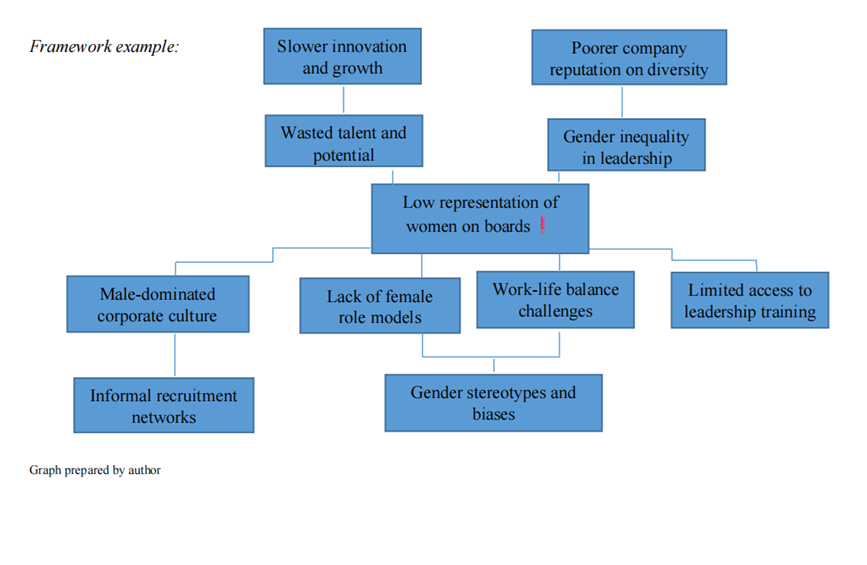
A ‘problem tree’ is an analysis tool that helps you understand the causes and effects of a problem as well as allowing you to logically organise information and prepare the ground for planning actions.
Start with an analysis:
- What is the scale of the phenomenon? Are there any statistics showing changes over time?
- What are the causes, social patterns, and barriers to equality in this area?
- What are women’s needs, both current and strategic?
- What regulations are in place: rules, statutes, strategies?
You can’t do everything – choose 1–2 key areas. The Pareto principle (80/20) can be helpful here – a small number of causes generate most of the effects. Focus on the most important ones. If, for example, the low percentage of women in management positions is due to gender stereotypes, it is worth proposing anti-discrimination training or mentoring.
Think about what can actually improve the situation. Eliminate the causes, not just the symptoms – then you have a better chance of changing the situation.
Think about what issue is close to your heart and will spark your enthusiasm to take action!
Resource diagnosis
The second element of the diagnosis is to identify the resources you have at your disposal and those in your environment.
Consider, among other things:
- What are your motivations, experience and competences?
- What authority and influence do you have in a given area?
- Who can support you?
- How much time do you have, can you invest resources?
- What trends (political, economic, social, technological) may help or hinder you?
Once you know what the problem is, what actions you need to take to solve it, and what resources you have at your disposal, it is time to define the goals of your advocacy.
Advocacy goals – what they are and what they are not

What they are NOT:
They are not goals related to solving a given situation such as changing beliefs or increasing the number of women in management positions in a company. Of course, when we take up advocacy, we hope that our actions will translate into this, but…
What advocacy goals ARE:
They are goals related to building support for our idea, convincing de
cision-makers to make a decision, etc. The goal may be to gain support among 200 people in our company.
For example, if you think that the best course of action in the current
situation would be to hold a series of workshops on gender stereotypes in the company, your goal is to convince decision-makers to organise such training and allocate appropriate funds for it.
The question arises: who are the ‘decision-makers’ in our company?
Main recipients of advocacy activities
Consider who has real influence over decisions. This could be the HR department, the finance department, the management board, the mayor, etc.

Remember: we build relationships with people, not institutions. An abstract ‘HR department’ will not have an opinion on the promotion of equality solutions, but a manager will.
The same applies at the local level – e.g., the mayor, councillors, the municipal secretary.
When identifying the main target audience, consider who has real influence on a given decision. Sometimes it is not the person whose job it is, but someone with informal authority and decision-making power.
Don’t forget about indirect target groups – potential allies.