
In this part, you will learn:
- What makes people get involved in activities?
- What is important when building support and gaining allies for advocacy activities?
- How to build an advocacy appeal?
Principles for mobilising people for action (when people are ready to support your demands and join in the proposed actions)
What makes people get involved?
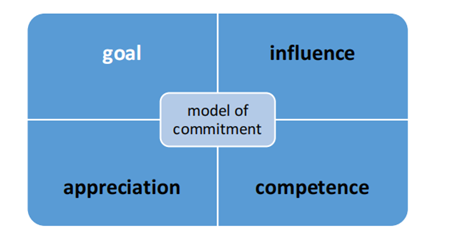
Graph BORIS training materials
AWARENESS OF THE GOAL
Be clear about the goals of the joint action. Make sure that everyone knows and understands them. Emphasise the values that guide you – people are more likely to get involved when they share your values.
HAVING INFLUENCE
Make sure that everyone can act according to their knowledge, skills, and influence. Give them space to carry out tasks and make decisions independently.
COMPETENCE
Make sure that the people supporting your activities have the competence to carry out their tasks. Set ambitious but realistic goals. Utilise people’s potential – give them the opportunity to work in line with their skills.
FEELING APPRECIATED
People work best when they feel noticed and appreciated, especially by their colleagues. Trust, recognition, and rewards increase their commitment.
***
Advocacy could also be defined as relationship building – establishing contacts, creating networks of allies and supporters.
Collaborative barometer and analysis of actors and people in terms of their impact on changing the existing situation
One of the tools you can use when looking for potential allies is the ‘Attitude Meter’.
Attitude meter – who is your potential ally?
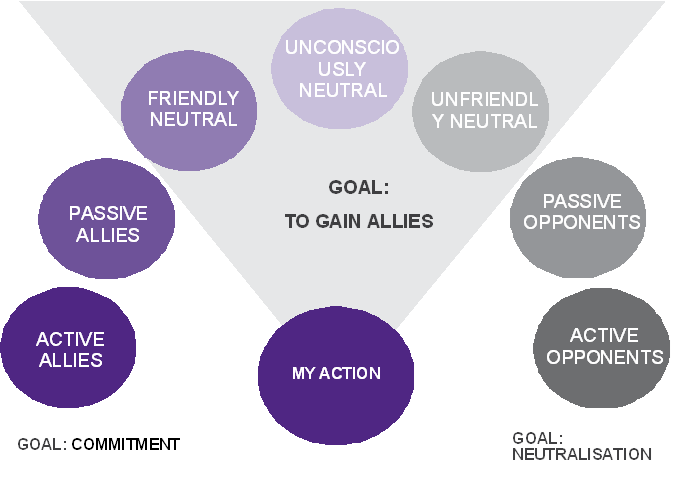
Analyse individuals, institutions, and organisations operating in a given area/region in terms of their attitude towards you, but also towards the problem itself and the solution you propose.
In your efforts to gain allies, it is worth focusing on those who are neutral. Of course, it is also worth targeting other groups but remember the 80/20 rule. In this case, invest 80% of your time in 20% of stakeholders. Do not invest too much time in those who are already convinced and those who are unlikely to be convinced.
Remember:

- identify your own needs and interests as well as those of your potential allies.
- ask about the needs and interests of the other party – what would have to happen for them to support us?
- prioritise interests and needs – what matters most to us and to the other party, what can we give up?
- take into account both substantive and procedural needs (e.g., meeting deadlines, achieving indicators) and psychological needs (e.g., security, acceptance, respect, influence or recognition).
Formulating an advocacy appeal
The advocacy message is the most important information explaining what you want to do and why, and what you expect from the audience you are addressing. The appeal must clearly indicate what you want them to do, e.g., sign a petition, make a donation, attend a demonstration, etc.
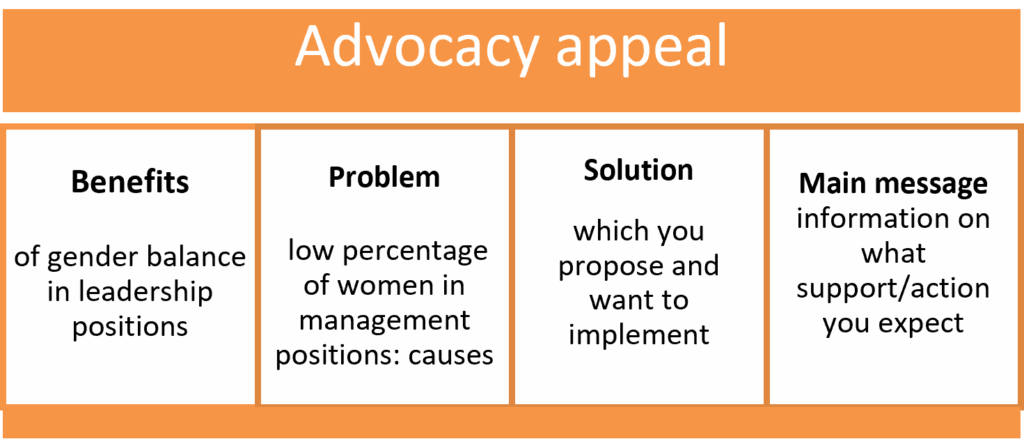
- The appeal must be short – both you and your audience need to remember it.
- The appeal must be simple – after hearing it once, I should understand what you want to achieve and how.
When constructing your message, pay attention to the two main components that may be present in each element of the message. These are

The heart should:
- Have a heroine/hero – a specific person or persons who are affected by the current situation and who indicate what might change in their life/work if your solution were implemented. You can also show a woman in a managerial position and refer to the benefits this brings to the institution and to the woman herself.
- Tell the story with details that make it unique. You can imagine it and identify with it.
- Appeal to emotions. Don’t just talk about the facts, but about how a person experiences a given situation.
The reason should:
- Use data and numbers. Replace generalities with specifics – replace terms such as ‘numerous’ and ‘many’ with specific numbers. Show data that the company/
 community can be proud of, not just data that describes the problem. Show data on the benefits of implementing the solution.
 -
Focus on 2-3 numbers that are most important from the recipient’s point of view, the most impressive ones. Do not present overly detailed numbers – say 38% or almost 40% instead of 37.87%.
-
Show numbers in a comparative way. Compare data with other places of a similar nature, e.g., with a region of similar size, structure, and problems, or data from one company but from different periods
Image source: Mohamed Hassan in pixebay
When constructing your message:
● Write/speak in short sentences – avoid commas and embellishments.
● Use colloquial language – say ‘money’ instead of ‘financial resources’, ‘schools and kindergartens’ instead of ‘educational institutions’.
● Use vivid expressions/metaphors – ‘when I walk into a meeting of 10 directors, only one is a woman’ instead of: ‘women are an underrepresented group among management staff’.
● Use verbs and the active voice – say ‘they learn’ instead of ‘skills have been acquired’.