
Questions for reflection
- How to plan gender equality activities in your country/region
If you want to take effective action to change the situation of women in your region/community, it is important to know that every change meets with greater or lesser resistance. This is because it disrupts the old order, reformulates old habits, and introduces new ones that we do not know, cannot use, and often fear.
In order to reduce resistance and ensure that a given action brings the desired results, and that they are sustained over time, it is important to know what to look for when planning it.
Kurt Lewin’s theory is helpful in this regard.
It says that if we want to introduce change, we should do so in three steps:
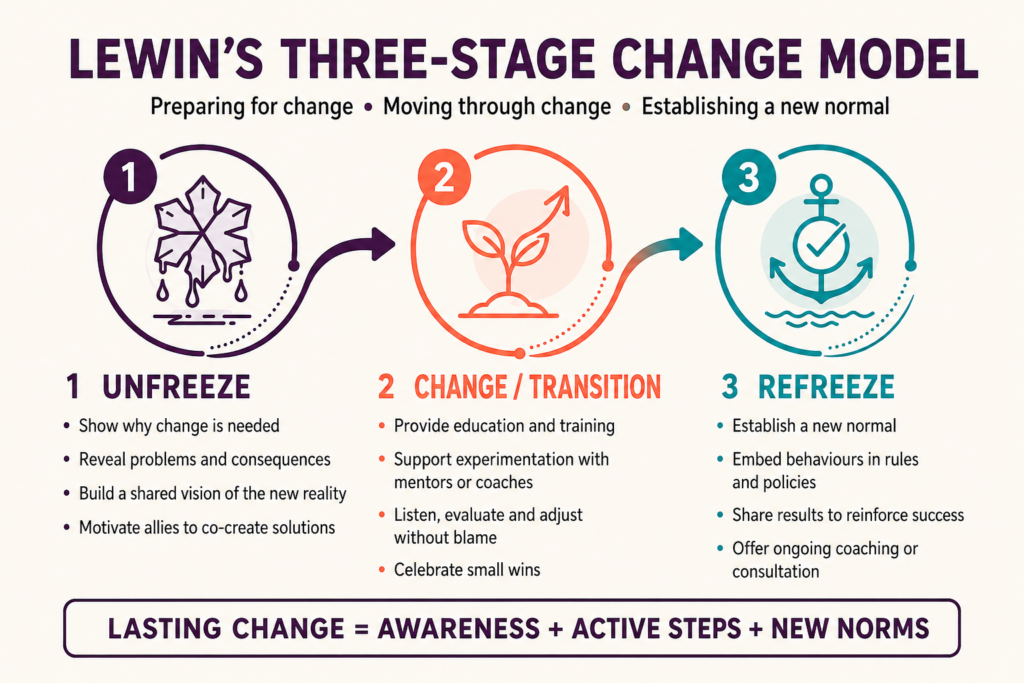
1.UNFREEZE
This is the preparation stage for change — questioning the status quo and making people aware that change is necessary.
Key actions:
- Raise awareness of the need for change by showing problems and their negative consequences.
- Build readiness by showing what the new reality could look like.
- Motivate action and build a group of allies to co-create solutions and demonstrate benefits for different groups.
2. CHANGE / TRANSITION
Now, new actions, values, and structures are introduced. People start learning and adapting, often facing fear or uncertainty — support is essential here.
Key actions:
- Provide education and training on new skills and beliefs.
- Allow experimentation, supported by mentors or coaches.
- Be open to mistakes. Listen to difficulties, evaluate progress, and adjust without blame.
- Celebrate small wins.
3. REFREEZE
This stage consolidates the change and establishes a new normal.
Key actions:
- Stabilise new behaviours through formal rules and policies.
- Reinforce success by sharing results.
- Offer ongoing support, e.g., coaching or consultation.
Lewin’s model is effective in managing both organisational and social change — e.g., promoting women’s rights, countering violence, or advancing gender equality.
It highlights that every lasting change requires:
- awareness,
- active steps,
- consolidation of new norms.
When planning your actions, take into account the 3 steps developed by Kurt Lewin.