
In the previous section, we showed you the situation for women in Europe, the importance of combating gender discrimination, and examples of actions that can be taken to promote equal rights for women and men. We also presented Kurt Lewin’s steps for change.
If you have identified an area in your region that needs to be changed to ensure equality between women and men or to combat gender stereotypes, and you feel that you want to address it, we invite you to take advocacy action.
We have provided you with European data to help you start the process of unfreezing change. Now it’s time for you to take action at the local level.
Your task at the thawing stage is to collect local data and prepare a list of benefits that will result from changing the current situation. In addition to improving working conditions and the quality of life for women, this may also include improving workplace relations, increasing family budgets, changing perceptions, etc.
After the thawing stage, it is time to take action to implement change.
What is advocacy?
Advocacy is action aimed at influencing the creation of favourable systemic and financial solutions that respond to the needs of the community.
What does this mean in terms of gender equality? If you see that women are not aware of their rights, you can, if you have the opportunity and resources, organise a one-off training session on the subject or publish a brochure. However, you may not always have sufficient influence or resources to take action. In such cases, you can try to bring about a situation in which people with the appropriate influence and resources carry out the action, e.g., organise a training session.
Advocacy is, therefore, directed at decision-makers. These are primarily local and central authorities. We can also direct it at decision-makers in our company, public institution, or non-governmental organisation.
You can be an advocate for groups to which you do not belong in order to support their voice, or you can be an advocate for a group of which you are a member. In this case, we talk about self-advocacy.
We encourage you to be an advocate for solutions that will benefit women in your community, and thereby you as well.
As a women’s advocate, you are also a self-advocate.
What is important for effective advocacy?
The aim of your advocacy activities will be to gain support among decision-makers, e.g., local government authorities, but also your superiors at work, school principals, etc., for solutions that are beneficial to women.
To be a good advocate, you need:
- Motivation – awareness of why you are doing what you are doing.
- A goal and a strategy – awareness of why and how you are going to do it.
- Competence – communication and negotiation skills and knowledge of
advocacy tools.
- Enthusiasm and perseverance – energy that will make others believe in what you say, but also patience, because advocacy is not a one-off action, it is a long-term, regular activity – a process of building support, mobilising people to take joint action, raising awareness of the problem, and promoting solutions.
Think about your motivation: to what extent does the issue you want to address also affect you? If so, it may be challenging for you to remain neutral and see the needs and arguments of the other side in order to effectively build counterarguments.
If not, the challenge may be to maintain your commitment.
Advocacy steps
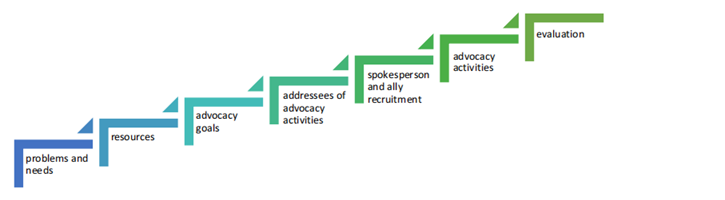
Graph prepared by the author
For your advocacy to be effective, you should first define the problem/need you want to address, your resources, and the resources available in the environment in which you operate. Then, set an advocacy goal and identify the entity/person who is key to making the decision. Next, gain allies and carry out a series of actions to get their support and influence the decision-maker. Finally, it is important to evaluate the effectiveness of your advocacy actions.