
Change as an opportunity? And what does our brain say about it?
Today’s world is increasingly dynamic, change and uncertainty are a natural part of it. However, change does not only happen in our environment, but it also naturally affects us, whether we are aware of it or not. Adaptability, or the ability to adjust to change, is one of the key elements of resilience. The ability to function in a world of uncertainty, overcome obstacles and develop flexibility are increasingly valued qualities.
However, our brains are set up in a completely different way and prefer stability and predictability to change. Any change can be evaluated by the brain as a potential threat that disrupts established patterns of behavior and requires mental energy to adapt. How can we explain this?
According to B. Andreatta (2018) the brain contents four structures that are related to change. These are the amygdala, entorhinal cortex, basal ganglia and habenula.
✅ Amygdala
The function of the amygdala is to ensure our survival. As soon as a potential threat appears, it activates the fight/flight/freeze/freeze instruction in our brain. The amygdala controls our emotions associated with the announcement of change, such as denial, fear, anger or frustration. Its cry would be, “I’m scared!”
✅ Entorhinal cortex
We can think of the entorhinal cortex as a kind of internal GPS. It contains a spherical cluster of cells that create maps of our physical environment and help us navigate it. In addition, this cortex tracks social relationships, noting power and kinship. When experiencing change, its voice would be, “I am lost.”
✅ Basal ganglia
The basal ganglia help us build new habits as we go through change. When we are learning something new, it is the basal ganglia that change the activity from something challenging that requires focus to easy tasks that we no longer have to think about. Their phrase would be, “I don’t know what to do.”
✅ Habenula
Habenula is responsible for decision making and action. When we make a decision that is in alignment with us, the brain releases dopamine and serotonin. However, if we make a decision that is wrong from our perspective, the habenula restricts the flow of these chemicals and we don’t feel good. During a change, the habenula might say: “I can’t go wrong.”
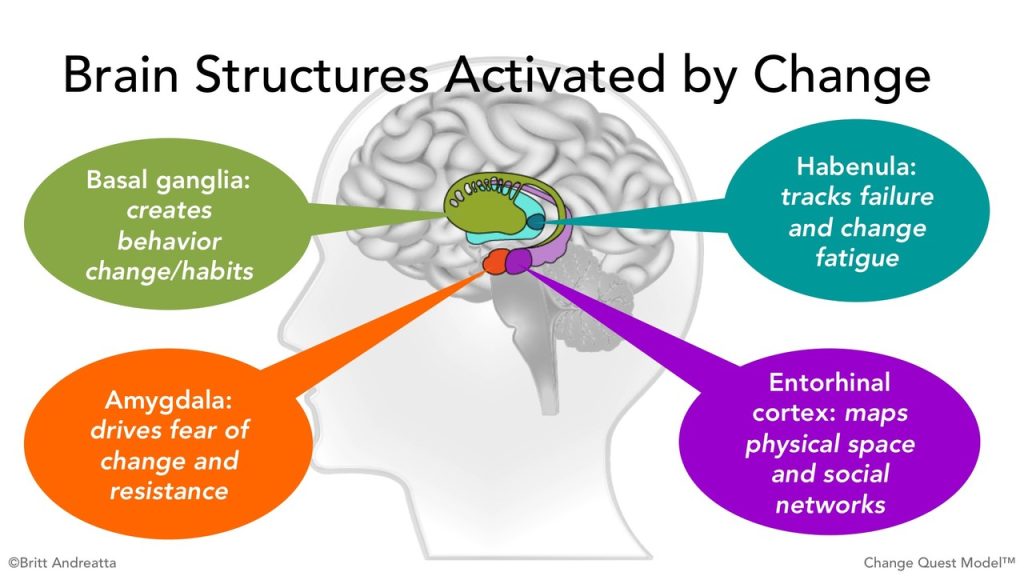
Source: ANDREATTA, B. New Brain-Based Tools for Launching SUccessful Change (1 in 3-part series). LinkedIn, 2018: https://www.linkedin.com/pulse/new-brain-based-tools-launching-successful-change-1-andreatta-phd/
👉 We now know how our brain works when it encounters change. How do we change our perception of change so we can use it as an opportunity? Read on to find out.
How to change the perception of change?
As we already know from the previous section, our brain can change, it is so called neuroplastic and capable of adaptation, but it prefers stability. However, if we want the brain to perceive change as an opportunity and not reject it, we need to actively develop strategies to help reframe change and reduce its negative impact.
The three basic strategies include:
✅ Reframing
When we perceive change as something negative, the brain activates defense mechanisms. However, if we reframe the change and perceive it as an opportunity for growth, the parts of the brain, such as the prefrontal cortex, that support rational thinking and adaptation are activated. So instead of asking “Why is this happening to me?” we can ask ourselves, “What can I learn from this?”
✅ Reduce uncertainty
If we reduce our uncertainty, for example by seeking more information, planning small, manageable steps, we will find a stable support – we will reduce amygdala activity which will not trigger a strong stress response.
✅ Developing adaptability
As we already know, our brains can change through what is called neuroplasticity, which is the ability to create new neural connections. By gradually exposing ourselves to change at a safe level, learning new things and regulating our emotions, we can gradually train and adapt the brain to change.
👉 Now you know how our brain works when it encounters change and what helps it cope with it and perceive it as an opportunity or challenge to grow. Let’s now take a closer look at strategies to help you cope with challenging changes and create positive habits.