
Gender equality in the 21st century: Why are we still talking about it?
In the 21st century, equal participation of women in public life should be something normal, something that no longer needs to be taught or fought for. Unfortunately, we still encounter unequal treatment of women and men.
Who are we? On identity and gender
Who we are begins with our primary identity. These are things we are born with or acquire in early childhood and cannot easily change. They include, among others: biological sex (whether we were born a boy or a girl), age, ethnic origin, and sexual orientation.
It is precisely these primary identity characteristics, including gender, which we cannot influence, that are protected by law and form the basis of anti-discrimination legislation.
But identity is not just how we perceive ourselves. It is also how others see us. Being a woman or a man is not just about biological sex. It is also a set of characteristics, behaviours, and roles that culture assigns to men and women. This is what we call gender, or socio-cultural sex.
Unlike biological sex, gender changes over time and place. How women are perceived, what is expected of them, and their position in society all evolve. We have an influence on this! Women’s actions have changed their role over the centuries, and our actions can bring about further change.
How are stereotypes formed?
People often build their social identity (i.e., their sense of belonging to a group, such as women or men) by comparing themselves to other groups. We divide people into categories, looking for similarities and differences. This process of categorisation begins in childhood. For example, seven-month-old babies can distinguish between male and female voices and then assign them to a generalised image of mum and dad, i.e., women and men.
It is a very short step from categorisation to stereotypes. The word ‘stereotype’ comes from ancient Greek and means ‘hard pattern’.
Stereotypes are opinions, beliefs, or simplified images of other social groups that are common within a given group. The problem is that stereotypes cause us to treat every person in a given group as if they had the same specific characteristics, even if this is not the case.
There are many opinions about the cognitive and social functions of stereotypes. The word comes from ancient Greek and means STEREÓS – solid, hard; TYPOS – pattern, imprint.
Stereotypes are opinions, beliefs, or cognitive patterns that are widespread in a given group and whose objects are other social or cultural groups. Stereotyping leads to the identification of each person in a given group with a specific set of characteristics.
Gender stereotypes are simplified descriptions of ‘masculine men’ and ‘feminine women’ shared by the general public and resulting from upbringing and socialisation in that society.
In our patriarchal culture, where male standards are valued more highly, men and women are expected to have different attitudes, behaviours, life orientations, and even character traits – thus, it is ‘appropriate’ for women to take care of the home and raise children, while men ‘should’ provide for them, while their domain is primarily professional work. Stereotypically, traits associated with emotionality, submissiveness, caring, and self-sacrifice are considered ‘feminine,’ while those associated with rationality, self-confidence, success orientation, aggressiveness, and a tendency to compete are considered ‘masculine.’
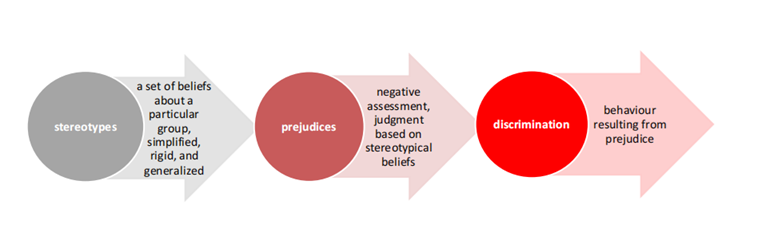
Discrimination based on gender is referred to as sexism – a set of views that form a specific ‘ideology’ treating one gender – women or men – as inferior. Sexism is the belief in the biological, intellectual, moral, or divinely established superiority of one sex over the other, or in the existence of other reasons why one sex deserves better treatment. In the labour market, sexism more often affects women (preference for men in hiring and promotion, lower wages for women in the same positions, lower representation in power structures, traditional beliefs about the superior position of men in the family, reducing women to the role of sexual objects). In family life, we also encounter anti-male sexism and the resulting unequal treatment of men (courts’ reluctance to grant fathers custody of children in divorce cases, social pressure to be the main breadwinner of the family).
Discrimination is a concept that applies to various minority groups. You can be discriminated against because of your age, level of ability, or psychosexual identity. If you are a woman over 50 and have a disability, you are discriminated against on the basis of three different characteristics of your identity. It, therefore, happens more often and its consequences are much worse for you. This phenomenon is called intersectionality (cross-discrimination).
Discrimination is not only legal restrictions or overt mistreatment. It is often also a mechanism of minor ‘harassment’, known as micro-inequities. When you speak in public and men smile knowingly, or when you are in the company of men and are asked to make coffee for everyone, even though you came to the meeting as an expert.
Discrimination and unequal treatment are characterised, among other things, by the fact that it is difficult for those who experience it to stop it themselves. Often, in order not to be rejected by the group, in order to conform to general rules, they reinforce the stereotype by behaving as society expects them to.
Stereotypes, prejudices, and gender inequality are still very common in Europe (European Commission report Gender equality and gender stereotypes_SP545_technical_report.pdf). Systemic and individual measures are constantly being taken at European and regional levels to change this situation.
In the following sections, we will show you how you can get involved in activities promoting gender equality.