
In the previous section, we showed you the situation for women in Europe, the importance of combating gender discrimination, and examples of actions that can be taken to promote equal rights for women and men. We also presented Kurt Lewin’s steps for change.
If you have identified an area in your region that needs to be changed to ensure equality between women and men or to combat gender stereotypes, and you feel that you want to address it, we invite you to take advocacy action.
We have provided you with European data to help you start the process of unfreezing change. Now it’s time for you to take action at the local level.
Your task at the thawing stage is to collect local data and prepare a list of benefits that will result from changing the current situation. In addition to improving working conditions and the quality of life for women, this may also include improving workplace relations, increasing family budgets, changing perceptions, etc.
After the thawing stage, it is time to take action to implement change.
What is advocacy?
Advocacy is action aimed at influencing the creation of favourable systemic and financial solutions that respond to the needs of the community.

What does this mean in terms of gender equality? If you see that women are not aware of their rights, you can, if you have the opportunity and resources, organise a one-off training session on the subject or publish a brochure. However, you may not always have sufficient influence or resources to take action. In such cases, you can try to bring about a situation in which people with the appropriate influence and resources carry out the action, e.g., organise a training session.
Advocacy is, therefore, directed at decision-makers. These are primarily local and central authorities. We can also direct it at decision-makers in our company, public institution, or non-governmental organisation.
You can be an advocate for groups to which you do not belong in order to support their voice, or you can be an advocate for a group of which you are a member. In this case, we talk about self-advocacy.
We encourage you to be an advocate for solutions that will benefit women in your community, and thereby you as well.
For: Transition Abilities
As a women’s advocate, you are also a self-advocate.
What is important for effective advocacy?
The aim of your advocacy activities will be to gain support among decision-makers, e.g., local government authorities, but also your superiors at work, school principals, etc., for solutions that are beneficial to women.
To be a good advocate, you need:
- Motivation – awareness of why you are doing what you are doing.
- A goal and a strategy – awareness of why and how you are going to do it.
- Competence – communication and negotiation skills and knowledge of
advocacy tools.
- Enthusiasm and perseverance – energy that will make others believe in what you say, but also patience, because advocacy is not a one-off action, it is a long-term, regular activity – a process of building support, mobilising people to take joint action, raising awareness of the problem, and promoting solutions.
Think about your motivation: to what extent does the issue you want to address also affect you? If so, it may be challenging for you to remain neutral and see the needs and arguments of the other side in order to effectively build counterarguments.
If not, the challenge may be to maintain your commitment.
Advocacy steps
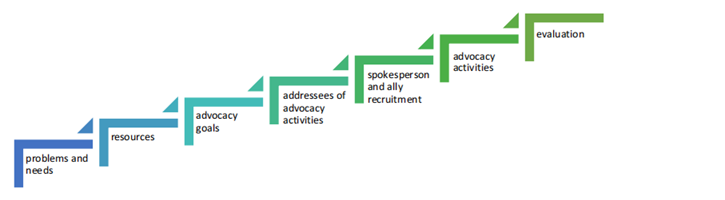
Graph prepared by the author
For your advocacy to be effective, you should first define the problem/need you want to address, your resources, and the resources available in the environment in which you operate. Then, set an advocacy goal and identify the entity/person who is key to making the decision. Next, gain allies and carry out a series of actions to get their support and influence the decision-maker. Finally, it is important to evaluate the effectiveness of your advocacy actions.
PART 2 diagnosing needs and resources, setting goals, and main recipients of advocacy actions for equal rights, equal opportunities, and equal treatment of women and men
Questions for reflection
- Two methods for diagnosing situations/needs and analysing resources (Methods and tools for situation and resource diagnosis)
- How to define advocacy goals and key recipients of advocacy?
Situation diagnosis
The first step in planning is always diagnosis. If you want to take action, you should consider what is preventing the issue from being resolved and what resources you have to take action to persuade influential people to address the issue.
First, decide what gender equality issue you want to address. Do you want more nurseries and kindergartens in your area so that women can return to work sooner? Perhaps you want your company to introduce more remote working? Or perhaps you want schools to teach children and young people that girls and boys should be treated equally? Or maybe you want your neighbours to stop thinking stereotypically about the roles of women and men.
Once you have identified the issue you want to address, think about the causes of the problem. What makes it the way it is? You can use the ‘problem tree’ method for this purpose.
How does a ‘problem tree’ work?
- Identify the main problem – place it in the centre (at the trunk of the tree).
- Identify the causes of the problem – write them down below (the roots of the tree).
Identify the effects of the problem – write them down above (the crown of the tree).

A ‘problem tree’ is an analysis tool that helps you understand the causes and effects of a problem as well as allowing you to logically organise information and prepare the ground for planning actions.
Start with an analysis:
- What is the scale of the phenomenon? Are there any statistics showing changes over time?
- What are the causes, social patterns, and barriers to equality in this area?
- What are women’s needs, both current and strategic?
- What regulations are in place: rules, statutes, strategies?
You can’t do everything – choose 1–2 key areas. The Pareto principle (80/20) can be helpful here – a small number of causes generate most of the effects. Focus on the most important ones. If, for example, the low percentage of women in management positions is due to gender stereotypes, it is worth proposing anti-discrimination training or mentoring.
Think about what can actually improve the situation. Eliminate the causes, not just the symptoms – then you have a better chance of changing the situation.
Think about what issue is close to your heart and will spark your enthusiasm to take action!
Resource diagnosis
The second element of the diagnosis is to identify the resources you have at your disposal and those in your environment.
Consider, among other things:
- What are your motivations, experience and competences?
- What authority and influence do you have in a given area?
- Who can support you?
- How much time do you have, can you invest resources?
- What trends (political, economic, social, technological) may help or hinder you?
Once you know what the problem is, what actions you need to take to solve it, and what resources you have at your disposal, it is time to define the goals of your advocacy.
Advocacy goals – what they are and what they are not

What they are NOT:
They are not goals related to solving a given situation such as changing beliefs or increasing the number of women in management positions in a company. Of course, when we take up advocacy, we hope that our actions will translate into this, but…
What advocacy goals ARE:
They are goals related to building support for our idea, convincing de
cision-makers to make a decision, etc. The goal may be to gain support among 200 people in our company.
For example, if you think that the best course of action in the current
situation would be to hold a series of workshops on gender stereotypes in the company, your goal is to convince decision-makers to organise such training and allocate appropriate funds for it.
The question arises: who are the ‘decision-makers’ in our company?
Main recipients of advocacy activities
Consider who has real influence over decisions. This could be the HR department, the finance department, the management board, the mayor, etc.

Remember: we build relationships with people, not institutions. An abstract ‘HR department’ will not have an opinion on the promotion of equality solutions, but a manager will.
The same applies at the local level – e.g., the mayor, councillors, the municipal secretary.
When identifying the main target audience, consider who has real influence on a given decision. Sometimes it is not the person whose job it is, but someone with informal authority and decision-making power.
Don’t forget about indirect target groups – potential allies.